· Oliver Newton · Press · 2 min read
Lurking in the dark: a large population of faint galaxies in the Local Group awaits discovery
Our prediction of undetected ultra-diffuse galaxies in the Local Group attracted attention from multiple science news outlets and institutional channels.
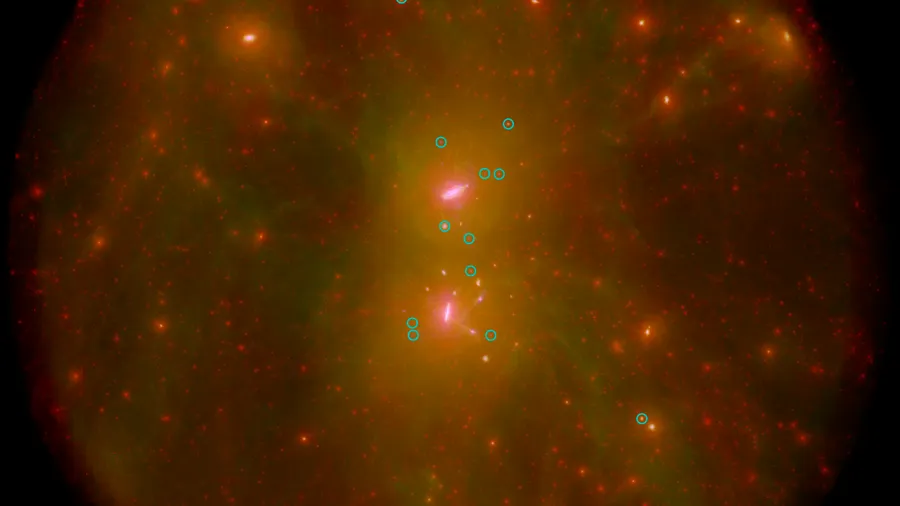
Undiscovered ultra-diffuse galaxies in the Local Group
An international team led by researchers based in Poland (CFT PAN, Dr Oliver Newton), Spain (IAC/ULL, Dr Arianna Di Cintio and Dr Salvador Cardona-Barrero), and Germany (AIP Potsdam, Dr Noam Libeskind) has made an exciting prediction that may shed new light on our understanding of the universe. Their study focuses on ultra-diffuse galaxies: faint galaxies with masses of up to one billion Suns (about one-thousandth of the mass of the Milky Way) that are spread over an area comparable to the size of our Milky Way. This makes them very faint and difficult to observe, and as a result they remain poorly understood.
The researchers believe that the Local Group, a small cluster that currently contains approximately 60 known galaxies, including the Milky Way and Andromeda, holds the best prospects for further discoveries. While only two ultra-diffuse galaxies have been found in the Local Group so far, the scientists believe that understanding the total number of ultra-diffuse galaxies in the Local Group is crucial to our understanding of the cosmos.
So, how many more lurk in our cosmic backyard? To find out, the international team examined state-of-the-art simulations of our cosmic neighbourhood. Named after the Ancient Greek goddess of the home, the HESTIA simulations are the most accurate and detailed simulations of the Milky Way and its immediate neighbourhood in existence. The simulations predict that there may be as many as 12 ultra-diffuse galaxies waiting to be discovered in the Local Group. Based on an analysis of the ultra-diffuse galaxies’ properties in the HESTIA simulations, the team believes several of these galaxies could be directly observable using existing data from surveys such as the Sloan Digital Sky Survey.
The discovery of these new galaxies could have far-reaching implications for our understanding of galaxy formation and evolution. Current models suggest that up to half of the low-mass galaxies in the universe could be extended and diffuse, and most of them will be unobservable with our current technological capabilities. As the number of galaxies in the universe is a strong prediction of various cosmological models, the size of the population of ultra-diffuse galaxies in the Local Group could be used to rule out some of these models.
The research, titled ”The undiscovered ultra-diffuse galaxies of the Local Group”, will be published in The Astrophysical Journal Letters on 30th March 2023.
ApJL: https://iopscience.iop.org/article/10.3847/2041-8213/acc2bb
ApJL DOI: https://doi.org/10.3847/2041-8213/acc2bb
arXiv: https://arxiv.org/abs/2212.05066