· Oliver Newton · Outreach · 2 min read
Pint of Science 2026
Discussing the cosmic web over a pint.

Caught In the Cosmic Web: a Pint-Sized Guide to Dark Matter
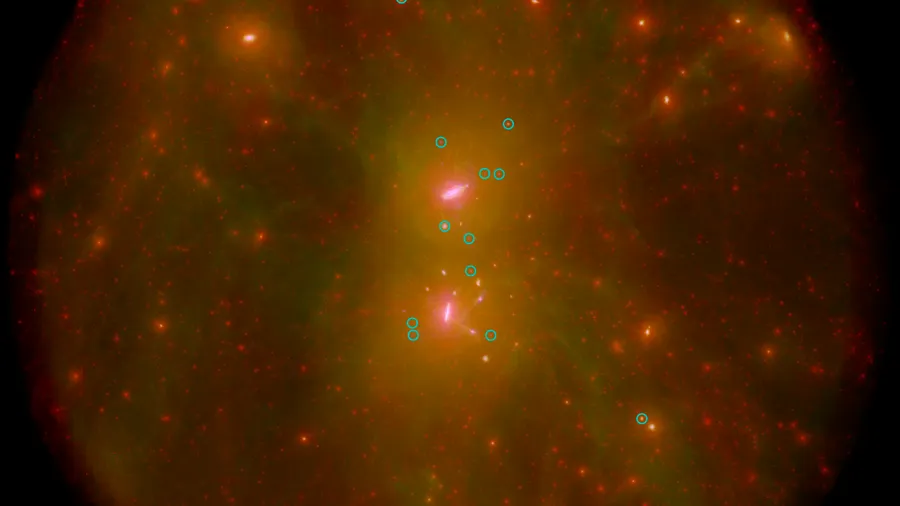
In our best picture of the Universe galaxies are suspended in a cosmic ”spider web”. However, the threads of this web, which hold galaxies together, are almost entirely invisible. We call this mysterious stuff dark matter, and it makes up about 85% of all matter in the cosmos. We can’t see it, and we haven’t found it in any lab experiments on Earth. However, we know it’s there because its gravity affects how stars and entire galaxies move through space. So, how do you study something you can’t see? You look at its effects on the things you can. Some of the best places to look are the tiniest galaxies in the Universe: dwarf galaxies. These faint, small galaxies are like cosmic fossils that are full of dark matter. This makes them excellent, ultra-sensitive laboratories for probing the properties of this invisible substance.
In my research at the University of Surrey, I investigate how these dark matter-dominated dwarf galaxies are affected by their environment within the vast threads of the cosmic web. By understanding how the biggest dark matter structures in the Universe interact with the smallest, we hope to unlock some of dark matter’s mysteries. Our work is also crucial for interpreting the incredible new images coming from telescopes like the James Webb Space Telescope (JWST), helping us to read the story of our Universe, one tiny galaxy at a time.
Come for a pint, stay for the cosmic mystery.
Location: The Star (Backroom), Guildford, UK
Time: 19:00-21:30
Event webpage